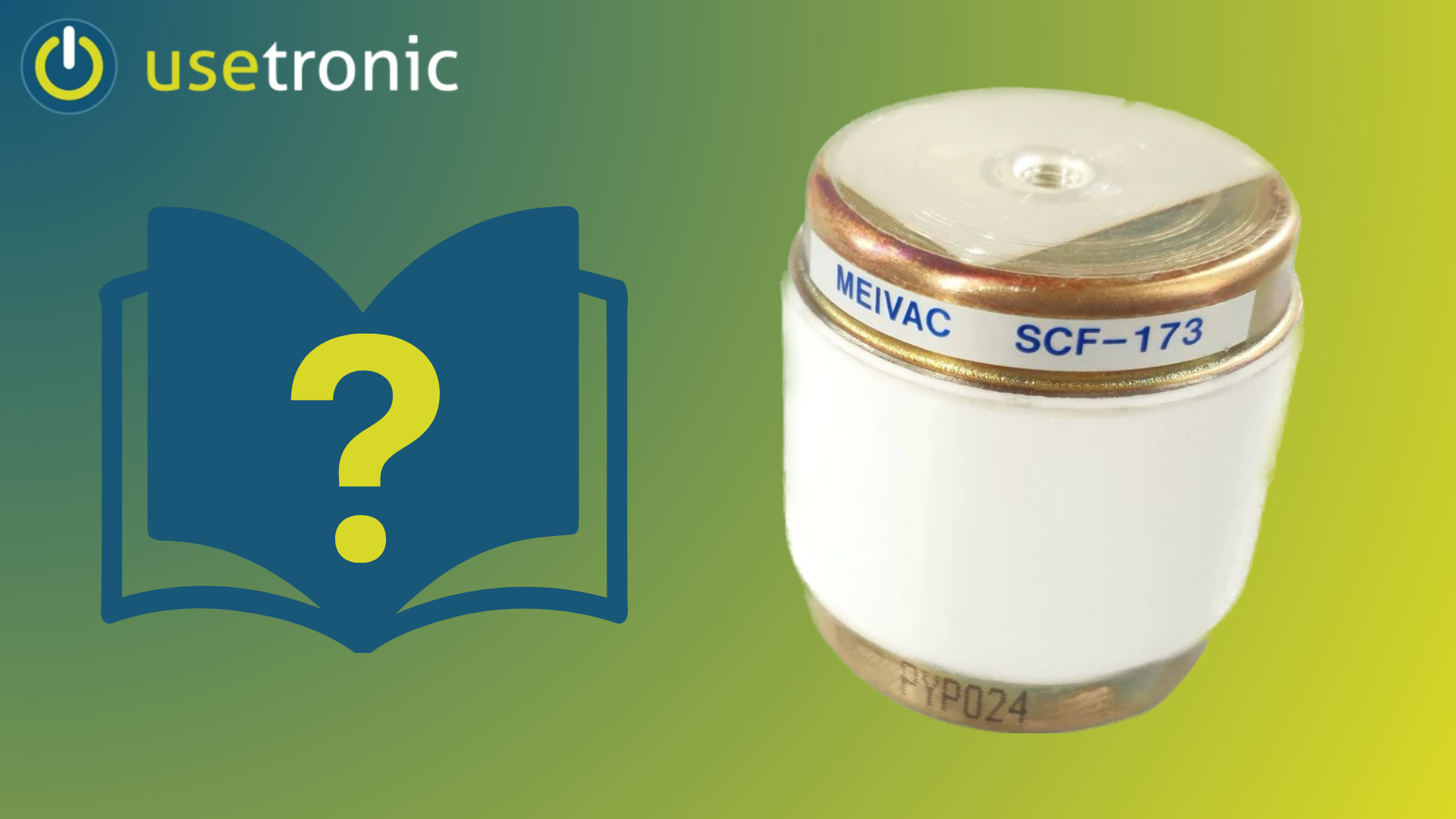
What Is a Vacuum Capacitor? Simply Explained
A vacuum capacitor is a special type of capacitor whose electrodes are enclosed in a vacuum. This allows it to achieve particularly high voltage resistance and excellent high-frequency performance. It is mainly used in RF technology, plasma technology, and industrial heating processes.
🔧 How Does a Vacuum Capacitor Work?
Like all capacitors, a vacuum capacitor stores electrical energy in an electric field between two plates. The special characteristics are:
- The insulating medium is a vacuum, not a dielectric like plastic or ceramic.
- A vacuum has virtually no free charge carriers – resulting in high breakdown voltage and low losses.
- The capacitance is often adjustable (e.g. via spindle or motor).
⚙️ Applications of Vacuum Capacitors
- RF heating: e.g. in metal processing or glass industry
- Plasma processes: semiconductor production, surface coatings
- Radio & transmitter systems: antenna tuning at high power
- Capacitor banks: energy supply for pulse systems
🔍 Advantages of Vacuum Capacitors
- ✅ High voltage resistance: up to tens of kV
- ✅ Low power loss: ideal for high frequency
- ✅ Durable & maintenance-free: no aging due to insulation materials
- ✅ Stable capacitance: even under temperature or load changes
⚠️ Disadvantages & Challenges
- ❌ Larger & more expensive than standard capacitors
- ❌ Mechanically sensitive due to glass/ceramic envelope
- ❌ Economically viable only for specialized applications
📊 Comparison: Vacuum vs. Ceramic Capacitor
| Feature | Vacuum Capacitor | Ceramic Capacitor |
|---|---|---|
| Voltage Rating | 🔝 Very High (up to >50 kV) | 🔸 Medium (up to ~2 kV) |
| HF Suitability | ✅ Excellent | ✅ Good |
| Size & Price | ❌ Large & expensive | ✅ Small & cheap |
| Typical Use | Industry, RF Power Systems | General Electronics |
🧠 Conclusion: When Is a Vacuum Capacitor Needed?
Vacuum capacitors are used when high voltages, precise frequency tuning, and low losses are essential. They are crucial in RF technology, plasma control systems, and high-power electronics – wherever standard capacitors reach their limits.
❓ Frequently Asked Questions (FAQ)
▶️ What is a vacuum capacitor?
A capacitor with electrodes enclosed in a vacuum. It offers high voltage resistance and excellent high-frequency performance.
▶️ What is a vacuum capacitor used for?
In RF systems, plasma processes, industrial heating, and broadcasting transmitters.
▶️ What’s the difference from a ceramic capacitor?
Vacuum capacitors are more voltage-resistant and suitable for RF, but also larger and more expensive.
▶️ Is the capacitance adjustable?
Yes – many vacuum capacitors are variable (rotary/trimmable), e.g., for transmitter tuning.