What Is a Thyristor? Simply Explained
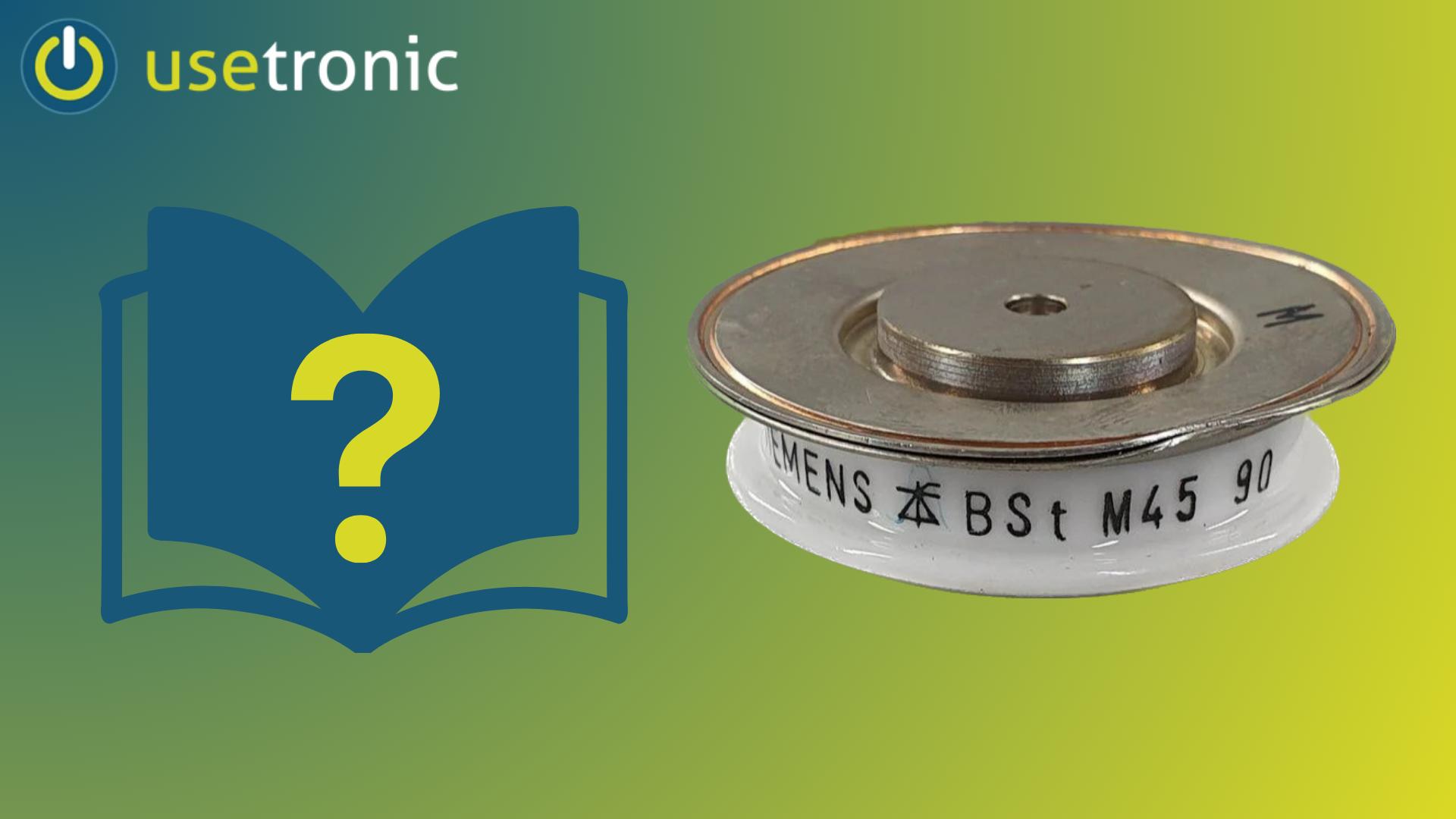
A thyristor is an electronic semiconductor device that functions like a switch. It allows current to flow in only one direction – but only after being triggered by a control pulse at the so-called gate. Once triggered, it remains conductive as long as current flows through it.
🔧 How Does a Thyristor Work?
A thyristor is internally built from four alternating p- and n-type semiconductor layers (a PNPN structure). The principle is as follows:
- 🟡 Without triggering, the thyristor blocks current like a reverse-biased diode.
- 🔌 A gate pulse “fires” the thyristor – it becomes conductive.
- ⚡ It stays on until the current flow is interrupted.
Unlike a transistor, a thyristor cannot be actively switched off – it turns off only when the current drops to zero (e.g., at the zero crossing in AC systems).
⚙️ Typical Applications of Thyristors
- Power control: e.g., in heating controllers, dimmers, motor drives
- Controlled rectifier circuits: for high loads
- Phase angle control: in lighting and induction heating
- Protection circuits: such as crowbar overvoltage protection
📊 Comparison: Thyristor vs. Transistor vs. Diode
| Feature | Thyristor | Transistor | Diode |
|---|---|---|---|
| Control | Turn-on only (Gate) | On & Off controllable | Not controllable |
| Use case | Power regulation | Signal amplification, PWM | Rectification |
| Direction | Unidirectional | Bidirectional possible | Unidirectional |
| Switching capacity | High | Medium | Low to medium |
✅ Advantages of Thyristors
- ✅ High switching power: ideal for large currents
- ✅ Cost-effective & robust: durable and simple design
- ✅ Efficient: minimal power loss when conducting
⚠️ Disadvantages & Limitations
- ❌ Cannot be actively turned off: only by current interruption
- ❌ Not suitable for high frequencies: due to slow switching
- ❌ More complex control: compared to transistors
🧠 Conclusion: When Are Thyristors Useful?
Thyristors are ideal power switches when high currents need to be handled with a simple and robust solution – for example in industrial automation, power supplies, or heating systems. Their greatest strength is reliability and switching power.
❓ Frequently Asked Questions (FAQ)
▶️ What does a thyristor do?
A thyristor conducts current only after a gate trigger. It remains conductive until the current stops.
▶️ How is it different from a transistor?
A transistor can be turned on and off actively; a thyristor only turns on via the gate and turns off only when the current stops.
▶️ Where is a thyristor used?
In dimmers, heating controllers, motor controls, power supplies, and rectifier systems.
▶️ What is a GTO thyristor?
A Gate Turn-Off thyristor (GTO) can also be actively switched off via the gate – unlike standard thyristors.